Monday, July 6, 2009

JULY 6, 2009 50 WAYS TO SAVE THE OCEAN #2 Get married on a wild beach

'The places we associate with love are the places we seek to conserve'


Although I am not married and don’t know if I ever will be I always imagined I would get married on a beach. I always imagined I would be married somewhere wild and beautiful like East Sooke Park near my home of Victoria, Vancouver Island. When I was younger my parents took my brothers and I on many hikes and barbeques in this park…and many of the gorgeous spots overlooking the ocean would be perfect for a wedding!

East Sooke Park (Photo source)

In 2006 I spent nearly a year working on a project studying the dolphin populations off the south coast of Kenya. Just prior to leaving for Kenya my parents and I went for dinner with their friends who had lived in Kenya many decades earlier. This amazing couple filled me in on life in Kenya during the pre-Lonely Planet days and told me about a beach, Tiwi Beach, where they had spent their honeymoon years earlier. It was great to hear their story and I grew excited anticipating the life I would live on the other side of the world in a very different country.


The white sandy beaches of Kenya

During my time in Kenya I put Tiwi Beach and their honeymoon to the back of my mind…that is until I decided to spend a weekend away there and also ended up having a very memorable romantic evening on this same beach. Tiwi beach is a gorgeous white, sand beach on the southeast coast of Kenya. Shortly after we arrived and set up camp my friend Sara and I went snorkelling in the coral rag tide pools typical of this part of the African coastline.

Tiwi Beach has two beautiful large tidepools; one shaped like Australia and the other like Africa. When you swim in 'Africa' you can swim into a cave and watch the bats flying overhead and then swim through a short underwater cave into another pool! It was absolutely fabulous! After a nice day on the beach my friend Sara and I decided to sit in the shallow, sun heated, tidal pools near our camp and eat cheese and crackers and drink wine.


The tidepool shaped like the African continent at Tiwi Beach, Kenya
(Photo source)

Upon returning to our camp we met up with our Austrian neighbours, two brothers who’d driven their big overland truck from Austria to Kenya. We spent the evening around a campfire with the two of them. They were living on this beautiful beach for a month while they recorded music for their band. I hit it off with one of them and our conversation next to the campfire went deep into the night with the sounds of the waves and crickets and the stars overhead as a backdrop to add the magic to the moment. It was one of those experiences that always stay with me and so will the memory of that beach. That place and the emotions attached to it will forever remain in my memory.

I have had romantic moments at the beach, ones that I will never forget, and I know that I, as would my parent’s friends who spent their honeymoon at the beach years before, would be deeply saddened if I went back to a place like Tiwi Beach and found the beach destroyed or polluted. I would feel my memory of a precious moment had also been changed or destroyed. It is these moments that give us that personal connection to the beach and drives us to protect it.

Friday, July 3, 2009

Shaw Ocean Discovery Centre Presented on June 23, 2009:

A talk by Dr. Peter Ross of the Institute of Ocean Sciences on “British Columbia’s Endangered Killer Whales: Can We Improve the Habitat Quality for the World’s Most Contaminated Marine Mammals?”

The Shaw Ocean Discovery Centre in Sidney, British Columbia opened their doors to the public on June 20, 2009. They then started their by-donation-to-speaker series on the 23rd starting with a wonderful presentation by Dr. Peter Ross of the Institute of Ocean Sciences. I was fortunate enough to not be out on a work rotation observing fish, and was able to attend. I, being the “whale nerd” that I am, scribbled some of the key points of Dr. Peter Ross’s talk in a notebook. These are the key elements that I believe we should all think about/take action against to help improve the habitat quality of endangered southern resident killer whales.

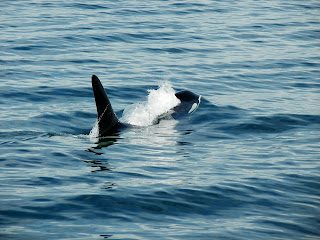
K21 - Member of K Pod which is part of the Southern Resident Community

The southern resident killer whales home range encompasses the Salish Sea (the water’s of Strait of Juan de Fuca and Haro Strait), which fall into two national jurisdictions. Therefore, their fate relies on the policies of the Canadian Species at Risk Act (SARA) and the United States National Marine Fisheries Services (NMFS). Three major threats have been determined to influence the fate of the southern resident killer whales: (1) prey availability, (2) noise/disturbance, and (3) toxic chemicals.

Toxic Chemicals

Toxic chemicals may have a direct or indirect impact on the endangered southern resident killer whales:

  • Toxic spills – might result in direct inhalation or ingestion. The Exxon Valdez oil spill in Prince William Sound demonstrated the direct impact of direct inhalation/ingestion when nine members of a unique “transient” killer whale the AT1s died after the March 24, 1989 spill. This pod only has seven remaining members of its initial twenty-two members.

  • “Food” contaminants – chemicals that might not directly impact the killer whales but have damaging impacts on their prey, in the case of the southern resident killer whales' Chinook Salmon. Utilization of fertilizers or chemicals that pollute or reduce oxygen quality in good fish habitat (cold, fast moving, and oxygen rich waters; spawning sites).

  • Chemical accumulation – persistent organic pollutants (POPs), with twelve considered the worst offenders being referred to as the dirty dozen. POPs are chemicals which persistent in the environment, bio-accumulate in the food web, and are consider toxic to the health of humans and environment. This has had a significant impact on the Northeast Pacific killer whale populations, which feed at or near the top of the food web. The southern residents are five times more polluted than the beluga whales in the St. Lawrence Seaway. The transient (mammal-hunting) are considered the most polluted marine mammal in the world, for they are the top of the oceanic food web.

The Three Most Significant Pieces of the Toxic Chemical Puzzle

Piece # 1: The Legacy

The persistent organic pollutants (POPs) are the most significant piece of the puzzle in the habitat of southern resident killer whales. Although, the United Nations Environment Programme Governing Council started to examine the “Dirty Dozen” in 1995, the chemicals’ roles as a persistent polluter were already in effect. Now despite being “widely” banned, the POPs i.e. Polychlorinated biphenyl (PCB) are still present in the Salish Sea and its inhabitants. The Southern resident killer whales have levels of PCBs well over the 17mg/kg lipid-1 threshold of immunotoxicity (toxins that suppress the immune system capabilities to defend against infections, etc.), witnessed in harbour seals.

The Northern resident community of killer whales will have to wait until 2030 for 95% of their population to fall to or below the 17mg/kg lipid-1 threshold, while the Southern resident community has until 2089. This will only occur if the “dirty dozen” remain banned and aren’t allowed to be traded to or utilized by developing nations. However due to the extreme bioaccumulation, in transient killer whales, the “legacy” of these banned chemicals might be around until the end of their existence.

Piece # 2: Dirty Backyards

The Southern resident killer whales utilize the waters off of Southern Vancouver Island, the Lower Mainland area of British Columbia, and the waters of Puget Sound off of Seattle and Tacoma. However, these surrounding waters act as the recreational and sewage sites for approximately 8 million people, which is significant considering the Southern resident population is 86 animals (as of July 2009). This population fluctuates between 80 to 100 animals. Therefore, human impacts on the marine sensitive environment of the Salish Sea are quite significant, i.e. over 8 million flushes of the toilet each day or the chemicals washed down to clean our house, etc. This means that if 8 million people made the minor adjustments to their lifestyles, such as biodegradable cleaning products, low-flush toilets, “killer whale” friendly lawns (local plants/vegetation vs. exotic plants) or pulling of weeds instead of chemical poisoning and practicing green boating, would result in a significant improvement to the habitat of the Southern killer whales. Refer to the Earth Day 365 Blog Post for tips on environmental friendly lifestyles.

The Low Flow Toliet in my Place - 6 Litres/1.6 Gallons

Piece # 3: Global Village

We are part of a global village. Therefore, the chemicals that we utilize are readily moved around the planet through atmospheric processes, oceanic currents, and biological migrations (food web). The Chinook salmon migrates out into the open Pacific Ocean to feed prior to returning their natal spawning streams off the coast of Western Canada and the United States. The salmon is feeding in the North Pacific sink for the chemicals from Asia and then transports them back to the Salish Sea. Each individual killer whale consumes 250 kg (500 lbs) of salmon daily, which results in an increase of contaminants being ingested from other pollutant sources. However, due to the boom of eco-tourism (i.e. salmon/halibut fishing and whale watching), we have a platform for environmental/conservational message for the killer whales and other marine wildlife. It allows for education of the public (local and global tourists) about global connectivity and that individual choices do have an impact. Therefore, individuals leave with the message that they can do something in their own “backyards” wherever it is in the world and have a positive impact on the marine environment. As a result, a global change occurs and improves the habitat of the Southern resident killer whales.

\

Monday, June 29, 2009

JUNE 29, 2009 50 WAYS TO SAVE THE OCEAN #1 : Go to the Beach

“When children explore tide pools, pick up and examine seashells along a golden shore, or build sand castles, they often discover a spark of wander that may inspire their life directions, bringing them to science, architecture, engineering, or a range of other callings” (50 Ways to Save the Ocean)

Edmonton, Alberta (Photo source)


I was born in Edmonton, Alberta, a city in the prairies and far from the ocean. I was 6 years old the first time I went to a beach on the ocean. My mother took my brothers and I on a trip to Victoria, British Columbia because, unbeknownst to us, she was thinking about moving us there. We instantly fell in love with this beautiful place, especially the ocean. I remember clearly, when during our visit, my mom took my brothers and me to a wishing well at the Olde England Inn, where we were staying, and we wished so hard we could move to Victoria. The wishing well worked for us because shortly after our visit my mom started planning our move to the west coast. In the fall of 1986 we found ourselves taking in the smells of the Pacific and the flowers of Victoria, our new home, as we crossed the tarmac at the Victoria airport!

My mom was very brave when she moved us to Victoria; she was a single mom in a new place with a new job and three kids. She used most of her pennies to fulfill her dream to move us here and so we didn’t have a lot. During that first year I never noticed we didn’t have much money. Life was fun…one big adventure. On most days, when school was finished, we explored the new city by foot and played at the beach just a half block from our house. We spent countless hours flipping rocks to look at crabs, exploring tide pools and chasing each other with slimy kelp fronds.

Willows Beach, Victoria

To live in a waterfront home was always a dream of my mother’s and soon after our big move to the west coast she met our step-dad and they fulfilled the dream when we moved into a house on Willows Beach in Oak Bay. How lucky we were! We absolutely LOVED living on the beach! The beach became our backyard…I ran on the sandy beach to prepare for future Olympics, constructed log rafts to travel to the South Pacific, enjoyed the accompaniment of gulls and seals, and we hit the ‘high seas’ in our stepdad’s 17’ boat to explore the nearby islands of Chatham and Discovery, fish for salmon and set crab and shrimp pots. We were very lucky because both my mom and step-dad made a point of teaching us to respect the environment and the animals living in it. If it were not for these beach adventures during my childhood I may not have the passion for the ocean I have today.

The beach makes you happy!

Now, even as an adult, I try to go to the beach to observe and explore as often as possible. In this age of information technology it is easy spend hours staring at a screen. I will never get the same inspiration about life from a computer screen; it is the wonderment of the living world that inspires me and my dreams to spend my entire life learning about and caring for the Ocean and it’s inhabitants.


Saturday, June 27, 2009

JUNE 27, 2009 50 WAYS TO SAVE THE OCEAN...things we can start doing today to help whales and other ocean inhabitants!

This summer I am working for Five Star Charters, a whale watching company, out of Victoria on the south end of Vancouver Island, BC. I feel blessed to do such work, to be outside on the water everyday seeing these magnificent animals and the habitat they live in.


Mount Olympus as seen from Race Rocks Marine Protected Area

This is not my first season doing this kind of work. In fact, it’s my 8th season doing marine ecotourism and I’ve also done 4 years of research locally and around the world. When guests on the whale watching boat find out I’ve been doing this as long as I have they often ask if I ever get bored of it or of seeing the animals. My answer is always ‘No, never!” because it only gets more interesting the more you are out there. They don’t realize that the one time or for the lucky ones, the 2 or 3 times, they go whale watching they only see a small fraction of what is happening out there. These whales are rarely in the same place doing the same thing but are always on the move…as I tell our guests the killer whales (Orcinus orca) can travel over 100 miles in 24 hours!

Members of K pod in the Endangered Southern Resident Killer whale community: K13 (far right) with her offspring from left to right: K20, K25 and K34


During our tours not only do the passengers enjoy watching the whales but we also tell them about their status and the environment we live in. The thing I like about our approach at Five Star Charters is that we like to talk about the entire ecosystem the animals live in. We explain why the whales are here, what oceanographic processes bring the food in that they eat which in turn brings them in to feed, socialize and breed.

Of course, it is very difficult to discuss the environment without also mentioning what has changed in the environment and what it is that has resulted in the reduced population size of many species of whale that we have today. In the Salish Sea this is especially true for the Southern Resident killer whale population which has been officially listed as Endangered in both the Canada and the US (see US listing info here, Canada designation).

This post is about what we can do as individuals, wherever we live on this great planet, to help the Southern Resident Killer Whales and other whales and inhabitants of the ocean; this includes ourselves who depend very much on a healthy ocean!


Recently I bought a great book called 50 Ways To Save The Ocean and I started to think I want to create blog posts, with full credit to the author (David Helgard of Blue Frontier) about these 50 great ideas. Whenever possible I’d like to add my own personal story of how I have incorporated these things in my life and how that has been for me. It would also be great to hear other people’s stories about taking these simple actions to help ‘save the oceans!”

So keep posted to see how I have and am increasing how I incorporate these 50 ways to save the ocean into my life!

POST #1 GO TO THE BEACH - Enjoy the sand and the water and leave it as clean as or cleaner than you found it... Go to WNU June 29, 2009 blog post

Saturday, June 6, 2009

HELP SAVE THE WILD PACIFIC SALMON...sign Alexandra Morton's petition to save BCs wild salmon

On March 30th this year we went to Port Townsend to the first Salish Sea Marine Naturalist Association meeting. This meeting allowed Canadian and American whale watching naturalists and scientists working in the Salish Sea, important habitat for the Endangered Southern Resident killer whale community (Endangered Species Act USA, Species At Risk Act Canada), to meet and discuss our work in this wonderful place. We were fortunate enough to learn the most recent findings from scientists studying the Southern Resident killer whale community and what these findings indicated we need to do to help this population to avoid further decline.


Members of the Endangered Southern Resident killer whale pod, J pod


The most emphasized issue in these discussions was the need to save the wild salmon stocks; the Southern Resident killer whales' main source of food. One of the presenters, a veterinarian, put it nicely...just as with your pet dog or cat, if they are well fed they should be able to deal with any other stress. If the Southern Residents have salmon they will better withstand stresses such as acoustic disturbances and toxins.


So what do we need to do? We need to seriously consider what we are doing about the salmon stocks of the Pacific coast in, not just BC, but all of North America. Just like the killer whales salmon see no boundaries so we need to work together, just as we came together at the Transboundary Workshop in March, to help the salmon.


Chinook salmon...the most important food of the Southern Resident killer whales

One of the most pressing issues related to saving the wild salmon stocks is the impact the commercial salmon farms have on wild fish. Check out and sign this petition from Alexandra Morton to make the BC government act more responsibly in their role to protect this Endangered (under SARA) whale's food...the wild Pacific Salmon!


Newspaper article in the Island Courier
Alexandra Morton's website Adopt-A-Fry

SIGN the petition !

Wednesday, May 13, 2009

Bike to Work Week 2009: MAY 11 - 17

Day 3 of Bike to Work Week 2009. Biking benefits not only a reduction of CO2 emissions into the environment but also cycling for a half hour a day can increase your life expentancy by up to 4 years according to How to Reduce your Carbon Footprint: 365 Simple Ways to Save Energy, Resources, and Money. If you don't own a bike or are unable to participate due to other physical limitations, look into other ways to commute to work such as walking, public transit or carpooling to do your benefit for the environment. A healthier environment equals a healthier you.

Celebration of Mothers….

And the role of mother’s in the types of marine mammals in the Salish Sea.

Mother’s day is celebrated around the world by various countries to celebrate and honour motherhood. General information of mother’s day from Wikipedia (the online encyclopaedia) indicates that it is celebrated on various days world wide; however two primary dates exist for “mother’s day”:

• The second Sunday of May, which is the larger of the two primary dates but is the more modern celebration of mother’s day. It started in the 20th century in the United States by Anna Jarvis, with many countries following suite including Canada.
• The smaller date is the fourth Sunday in Lent, which comes from the United Kingdom’s “Mothering Sunday” celebration. This tradition dates back to the 16th century.

The observance of Mother’s Day around the world is relative recent occurrence as it has evolved from North America and Europe. However, some festivals and celebrations of honouring mothers have existed prior to pre-colonization (i.e. Africa). Mother’s day gives us an opportunity to provide our mother with a little extra love and attention. The hectic-ness of life usually reduces our opportunities to spend quality time as a family and to appreciate all the things our mom (and dad) does to make our life easier. Therefore, getting together on mother’s day as a family to celebrate all that our mom has done for us i.e. driving us to practices, shopping, etc. is special and helps to improve our family relationship.

We all know the role that our mother’s have played in our lives, but what are the roles of mother’s in the types of marine mammals in the Salish Sea?

The Pinnipeds (Seals and Sea lions)

The Salish Sea is utilized by primarily four species of pinnipeds or the wing-footed mammals. Two species from the family Otaridae (eared or fur seals and sea lions) and two from the family Phocidae (true seals). The male California (Zalophus californianus) and Steller (Eumetopias jubatus) sea lions utilize the Salish Sea as winter haul out and foraging grounds. In May, the majority of the male Steller sea lions have staked out and defend key breeding territories on remote rookies in Northern British Columbia and Alaska. The females arrive later giving birth to their pups that they carried for 11 ½ months, and then proceed to lactate for up to 3 years. The majority of the pups are weaned after a year, which allows the female to start nursing the next pup which was conceived 11 to 14 days after the birth of the other pup. The male California sea lions proceeds south in the spring to breeding colonies off of California and Mexico. The females give birth to their pups from late May through July, which they’ve carried for 9 months, and remain ashore with their pups for up to ten days. The females then return to sea on foraging forays that may last up to 3 days; however the females will return to the shore for a day to nurse their pup. The pups sometimes join their mothers on foraging events, but majority remain on shore in large social groups. After six months, pups are abruptly weaned and abandoned (goodbye mom and thanks for life). The female California sea lion will be ready to mate twenty to thirty days after the birth of their pup, but has the ability to delay the implantation of the fertilized egg by three months. As a result, the female sea lion is not pregnant for only one month out of the year. Could you imagine being pregnant for the majority of your life span?

The phocids or true seals in the Salish Sea utilize the area either year round or for the majority of the year. Harbour seals (Phoca vitulina) are found in the Salish Sea year round. The Harbour seals are quite territorial of haul out sites from sandy and pebbly beaches to intertidal rocks and ledges, which they tend to, forage and feed off of. The female Harbour seals haul out to give birth to their pups in the summer months June through August. The pups are able to swim and dive immediately, but usually hitch a ride on mom’s back using their fore flippers. The pups are nursed for three to four weeks, then abruptly weaned and abandoned by their mother. The females then mate shortly after the weaning process. Mommy! The three week nursing period is similar for the Northern elephant seal (Mirounga angustirostris), except the female remains ashore on the sandy beach, fasting and defending her pup from other females and pups. After the three weeks is up, the pup is weaned by desertion. However, the female mates with the dominant bull elephant seal whose territory she’s given birth in just prior to the weaning of her current pup. Although, the majority of the northern elephant seals are breeding off the coast of California and Mexico, utilizing the Salish Sea for the majority of the year as foraging sites and molting sites. The first witnessed birth of a Northern elephant seal occurred at Race Rocks Marine Protected Area. Although, three weeks seems incredibly short, the phocids lactation period ranges from 4 to 50 days within the various species. The pups may not receive long periods of motherly love but thankfully the milk is richer than any other marine mammals from 45 – 60% fat.

The Mysticetes (Baleen Whales)

Although the Minke whale (Balaenoptera acutorostrata) is the most common and widely distributed of baleen whales, very little is known about the Minke whales reproduction and breeding. Hein bank in the Salish Sea is an incredibly productive summer feeding ground for the Minke whales, however, no mother-calf pair sightings have occurred at this feeding site. This indicates that weaning might occur prior to arrival at summer feeding grounds. The locations of Minke whale calving grounds for the Minke whales that forage in the Salish Sea are still a mystery for the whale referred to as the commoner. Unlike the Minke whale, the other baleen whales that utilize the Salish Sea as summer feeding grounds arrive with their offspring.

The Gray whale (Eschrichtius robustus) calves are independent of their mothers just prior to the fall migration back to the warm, breeding lagoons off the coast of Baja California. However, the migration to the northern feeding grounds of the Salish Sea is filled with perils for the Gray whale cow-calf pairings, with attacks from Southeast Alaskan transient killer whales. Gray whales defend their calves from these attacks, indicating a strong cow-calf connection, although not every mother is successful (BBC Blue Planet Disc 1 – Ocean World footage).

In recent years (late-1990s), cow-calf pairings of Humpback whales (Megaptera novaeangliae) are being seen in the Salish Sea, which means the Humpbacks are recognizing and teaching their calves that this is part of their summer feeding grounds. Humpback whales were hunted and removed from British Columbian waters, with the last whaling station in Coal Harbor closing their doors in 1968. Therefore, new humpback calves are learning to utilize this area prior to the return to the warm tropical breeding waters off of Mexico, Hawaii and even as far away as Japan. The return to these breeding grounds is the end of the cow-calf pairing, for the mothers have now taught them the official migration route from the breeding grounds to feeding grounds and back again. The majority of baleen whales experience a birthing interval of two to three years, with a twelve month pregnancy. However, the Minke whale might be an exception giving birth annually.

The Odontocetes (Toothed Whales, Dolphins and Porpoises)

The Salish Sea is incredibly unique that it is part of the home range of the largest oceanic dolphin, the killer whale (Orcinus orca) . It’s utilized by two different ecotypes of killer whales, transients (mammal-hunting) and residents (fish-hunting). The Northeast Pacific killer whales are some of the longest studied marine mammals since the early 1970s, with the Centre for Whale Research being set up to study the Southern resident community of killer whales. The research of Northeast Pacific killer whales has revealed a complex social structure in these animals. The social structures of killer whales are incredibly unique because it has reviled that killer whales are cultural based mammals. These culture traditions such as hunting techniques and language are taught by the females, for killer whales are a matriarchal society. The base social level of killer whales is the matriline, which is made up of a female and her offspring (both juvenile and adult male and females). A killer whale pod consists of several related matrilines that contain a common maternal ancestor. The clan is the next level in the social structure of killer whales, which indicates the relatedness of pods through the vocal dialects that they speak. Similar dialects of clan members reflect the common matrilineal heritage of the pods. The community is the last level of the social structure, and is made up of pods that associate with one another quite regularly. Therefore, killer whales demonstrate one of the most significant maternal connections in marine mammals. What’s an empty nest? Killer whales also experience the longest gestation of any marine mammal ranging between 15 to 18 months, and calves may not be weaned until two years of age.

Two of the six porpoise species, forage and reproduce in the Salish Sea. The Harbour porpoise (Phocoena phocoena) is highly elusive around vessels but huge foraging associations are witnessed in highly productive areas in the Salish Sea. The breeding season for the harbour porpoise appears to be late summer in the Salish Sea. The male harbour porpoise breeds with multiple females due to their weighty advantage of largest testes-to-body size ratio. Sexually mature females are able to give birth annually; therefore the females are under nutritional stress for most of their adult lives, due to overlapping periods of lactation and pregnancy. Due to the elusive nature of the harbour porpoise, mother-calf pairings are a rare sight. Unfortunately, my first sighting of a mother-calf pairing of a harbour porpoise ended with the calf being utilized/consumed as a teaching tool for T100D a young transient killer whale by his or her mother T100. It was AWESOME! During the productive summer months in the Salish Sea, the male Dall’s porpoise (Phocoenoides dalli) escort and breed with a single female since they aren’t as “ballsy” as the harbour porpoises. The following summer months, after nearly a year gestation period, a new calf is born. However, the new calf surprisingly might not be only a Dall’s porpoise but a hybrid between a Dall’s and a Harbour porpoise. Those harbour porpoises are definitely “ballsy” mating with one of the fastest cetacean species. Similar to the Harbours the Dall’s females in their prime probably give birth annually, but might not be a stressed due to a shorter lactation period of two months to eight months.

National Audubon Society: "Guide to Marine Mammals of the World" 2002 Chanticleer Press, Inc.